
We offer three complementary services designed to establish, strengthen and digitally enable governance across ICT Third Party Risk Management and Contract Management.
ICT Third Party Risk Management, Contract Management (CMS-based) and Contract Lifecycle Management (CLM) Software Implementation support organisations at different stages of maturity — from building a structured operational foundation to scaling governance through advanced digital enablement.

Click to read more
Our ICT Third Party Risk Management service provides your organisation with a structured and auditable framework for identifying, managing and documenting ICT-related third-party risks.
Our ICT Third Party Risk Management service is typically the right choice when you:
- Are subject to DORA, NIS2 or similar regulatory requirements
- Need structured oversight of ICT third-party risks
- Must strengthen executive accountability and audit readiness

Click to read more
The Contract Management service is for organisations looking to implement a CMS-based Contract Management framework covering the full contract lifecycle from pre-award to post-award.
Our Contract Management service is typically the right choice when you:
- Lack overview and ownership across contracts
- Experience inconsistent lifecycle follow-up
- Need a structured, CMS-based operating model readiness

Click to read more
We support your organisation in the selection and implementation of a CLM platform aligned with your governance maturity and operating model.
CLM Implementation is typically the right choice when you:
- Already operate structured Contract Management governance
- Need stronger digital enablement and reporting
- Are scaling beyond manual or basic system setups
- Require deeper integration into your enterprise architecture
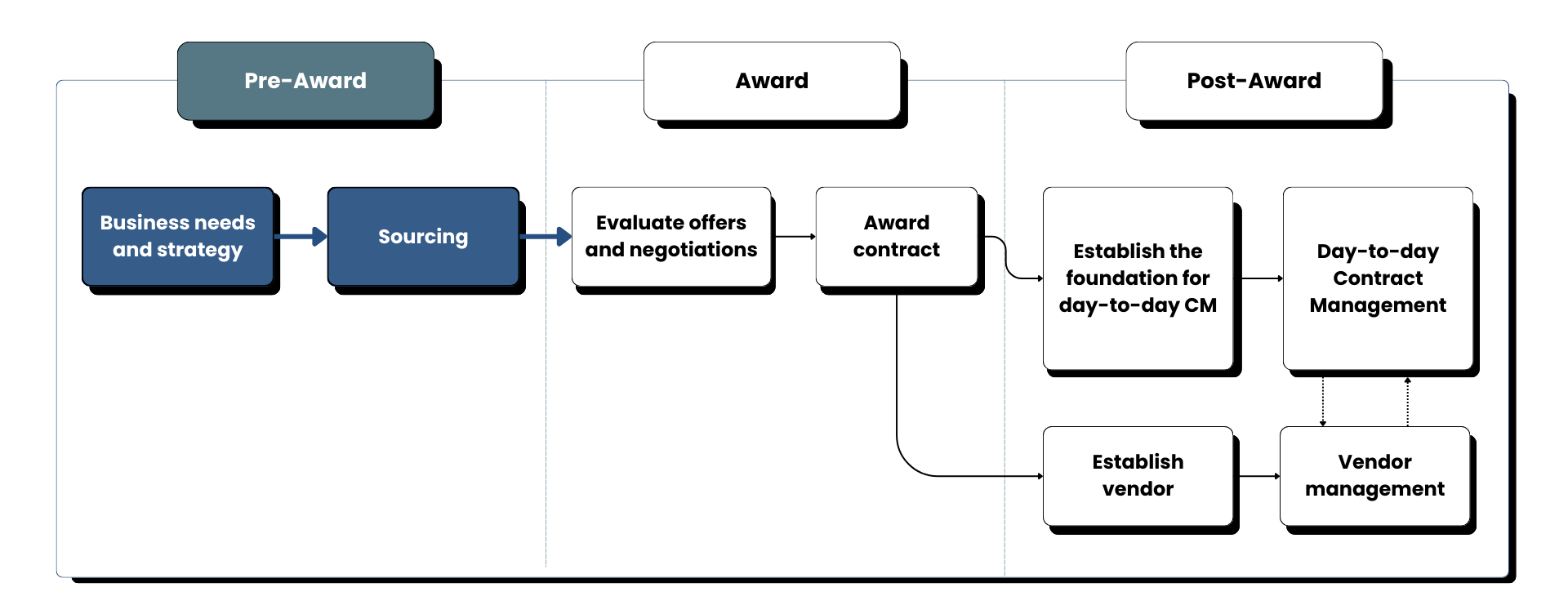
Our Operating Model covers the entire contract lifecycle. It brings together all the essential elements needed to operationalise both your third-party risk management and contract management processes.
Our Operating Model is built on a simple principle: processes alone do not create operational impact.
Processes only deliver value when they are embedded within a broader and integrated framework that defines how the organisation is structured, governed and supported in practice.
Our Operating Model therefore consists of a complete, standardised and integrated framework, consisting of:
– Strategy, Governance and Organisational anchoring
– Policies, Procedures and Practical templates
– Processes and Controls
– Clearly defined roles, Competencies and Training
– Systems and data
By establishing these elements as part of the same framework, we ensure that processes are supported by clear ownership, organisational alignment and the necessary capabilities to operate them effectively.
Without this standardised framework, even well-designed processes risk becoming fragmented and inconsistently applied.
This is why we implement frameworks — not isolated processes.
We help organizations translate complex regulations like DORA and NIS2 into clear, actionable requirements. By identifying the provisions that matter most, we enable companies to align their Third-Party Risk Management (TPRM) strategies with regulatory expectations.
We provide a standard governance structure that defines decision-making, accountability and organisational positioning. Rather than designing governance from scratch, we implement a proven model that is adjusted to your structure and leadership model, ensuring clear ownership from day one.
We deliver a complete set of standardised policies, procedures and ready-to-use templates aligned with recognised best practice. These are adapted to your organisation’s context, eliminating the need to draft documentation from the ground up while ensuring consistency and clarity across the framework.
We implement end-to-end standard processes supported by a defined set of controls. These are based on established standards and practical experience, ensuring that execution, follow-up and oversight are embedded from the outset — without the need for bespoke process design.
We introduce a predefined role model with clearly described responsibilities and competency requirements. Targeted training and enablement material are included, ensuring that stakeholders understand their role and are prepared to operate the framework effectively.
We provide a standard system configured with predefined data structures, metadata and reporting logic. This ensures transparency, traceability and consistent execution from the start, removing the need for complex system design or configuration projects.
Our Framework seamlessly guides you through the three phases of the contract lifecycle—making the process intuitive, efficient, and easy to implement
Pre-Award
In our framework, the pre-award phase focuses on clearly defining and validating the business need before engaging the market. We structure requirements, confirm budget alignment, and ensure policy compliance.
Sourcing activities are initiated under defined governance, and third-party risk management is embedded through due diligence, screening, and risk assessments to ensure only qualified and compliant vendors proceed.
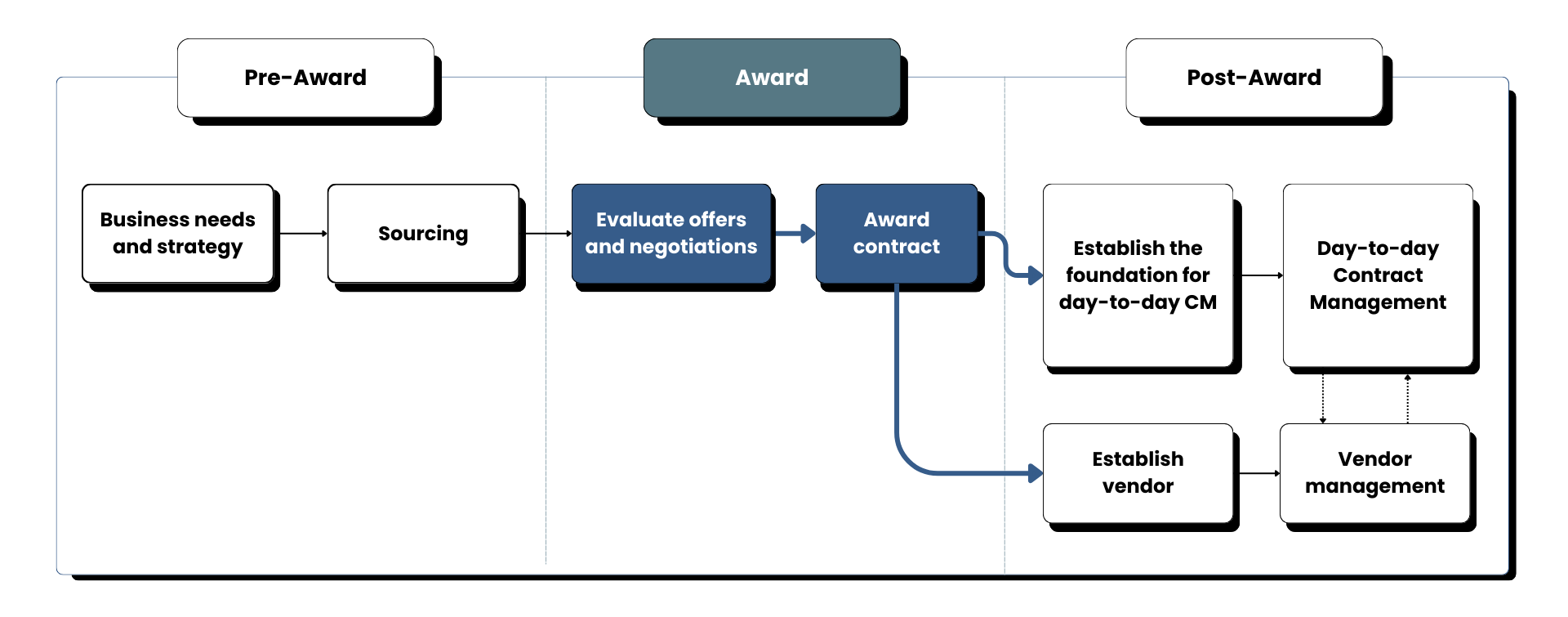
Award
In the award phase, our framework guides the structured evaluation and selection of the right vendor based on commercial, technical, and risk-based criteria.
Decision-making is documented, approvals are obtained according to delegated authorities, and negotiations ensure appropriate risk allocation and compliance obligations are reflected in the contract.
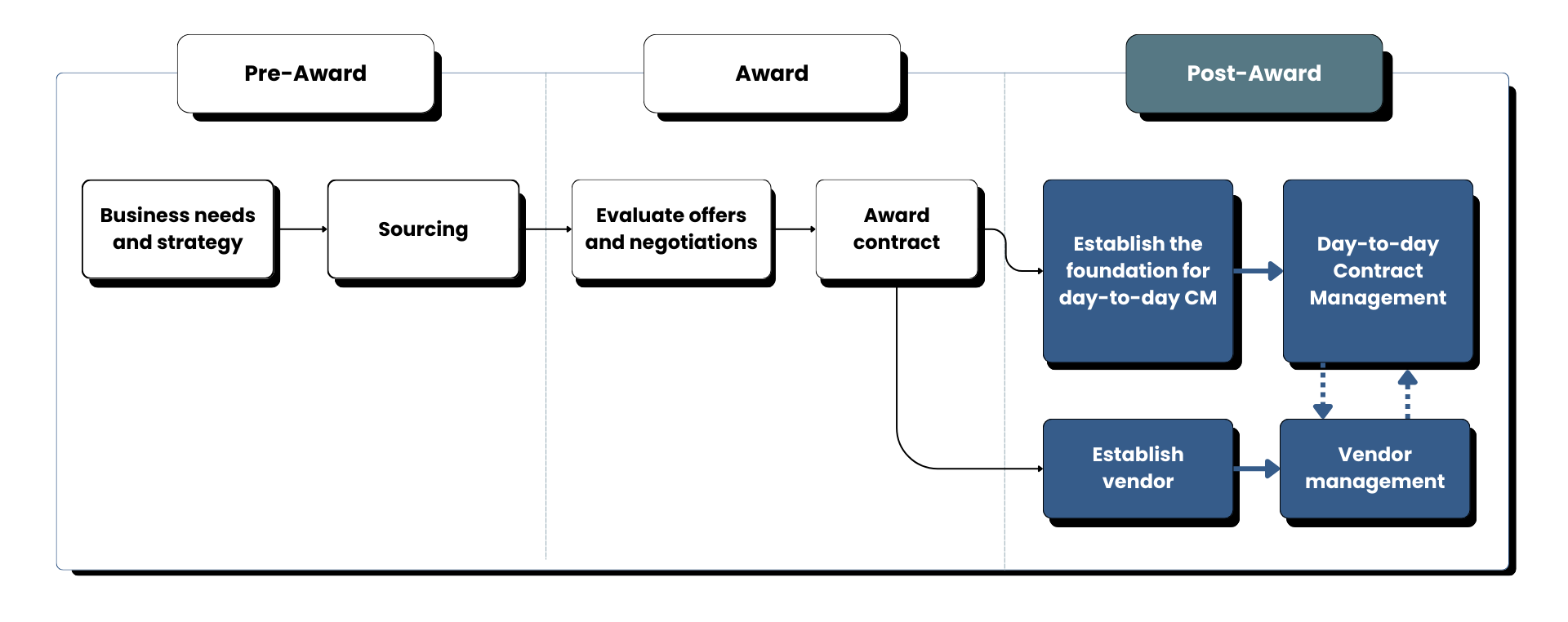
Post-Award
Post-award, our framework ensures continuous oversight of vendor performance, contractual obligations, and compliance requirements.
Third-party risk management remains active through ongoing monitoring, periodic reassessments, issue and dispute management, and renewal governance.
This approach secures value delivery while proactively managing risk throughout the contract lifecycle.
